
Let’s play a little game.
Tomorrow morning, your boss calls.
“John, we need to talk.”
And before you know it, you’re sitting at home in your underwear wondering how long you can make $1 million last.
Okay, maybe skip the underwear part.
But here’s the serious question:
What would you do if you had to retire tomorrow?
Not five years from now. Not when the market is behaving nicely. Not when everything lines up perfectly.
Tomorrow.
For this example, let’s say I’m 55, my wife is 51, and I have $1 million sitting in my 401(k).
I need $60,000 a year to live the way I want.
The first thing I would NOT do is panic.
The second thing I would NOT do is call my buddy who made 40% in some stock last year and ask him what I should do with my retirement.
Instead, I’d build a bridge from the money I have today to the income I’ll need for the rest of my life.
And that changes everything.
Step One: Protect the First Five Years
At 55, I’d be very careful about rolling my entire 401(k) into an IRA.
Why?
Because the Rule of 55 may allow qualifying withdrawals from my employer plan without the 10% early-withdrawal penalty if I leave my employer during or after the calendar year I turn 55.
That could be extremely valuable.
So before moving money around, I’d make sure I understood exactly what my plan allows.
Translation: I wouldn’t shoot first and read the IRS rules later.
Step Two: Turn Part of My Savings Into Future Income
Now let’s say I take $450,000 of my hypothetical $1 million and use it for an annuity with an income rider.
That leaves $550,000 outside the annuity.
If I need $60,000 a year for the next five years, that’s $300,000.
So, in this simplified example, I could reach age 60 with approximately $250,000 still outside the annuity.
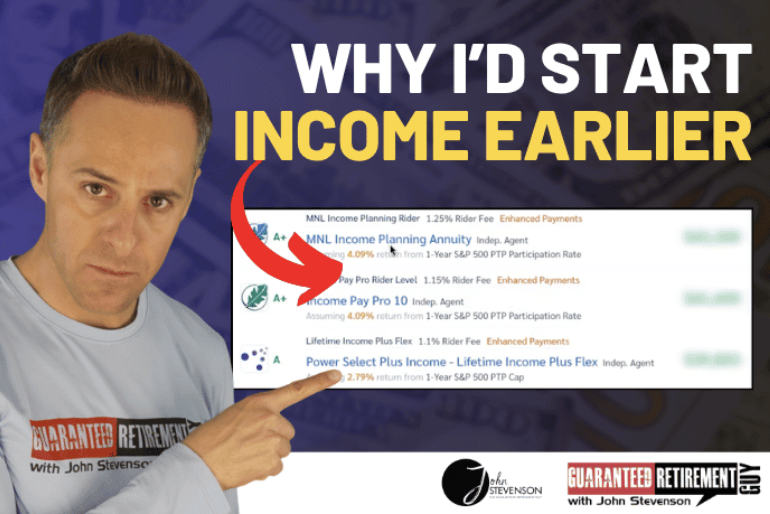
And the $450,000 annuity could produce approximately $43,200 a year starting at age 60, based on the illustration in my video.
Suddenly, I’ve got something incredibly valuable:
A paycheck I don’t have to go to work for.
Now we’re talking.
Step Three: Build the Bridge to Social Security
The annuity gives me $43,200.
My target is $60,000.
That leaves a gap of $16,800 a year.
If I start Social Security at 62, I only need to bridge that gap for roughly two years.
That’s about $33,600.
Then let’s assume my Social Security benefit is $30,000 a year.
Now I have:
- $43,200 from the annuity
- $30,000 from Social Security
- $73,200 total income
My original goal was $60,000.
So I’m now $13,200 above my target—before taxes—and I still have money sitting outside the annuity.
That’s what I call giving your retirement a fighting chance.
But What If I Wait Until 62?
Here’s where retirement planning gets interesting.
If I waited until 62 to turn on the annuity income, the same $450,000 illustration produced approximately $52,000 a year.
Add the hypothetical $30,000 Social Security benefit and I’m looking at roughly $82,000 a year.
Sounds fantastic, right?
Except there’s a catch.
I’d have to fund seven years of retirement first.
At $60,000 a year, that’s $420,000.
Which means I’d have roughly $130,000 left outside the annuity.
So yes, waiting could produce more income.
But I’d have significantly less money available to me.
Personally, I like the balance of starting around 60 and keeping more flexibility.
Because retirement isn’t just about maximizing a number on a spreadsheet.
It’s about having enough income AND enough freedom.
The Big Lesson
Would I put my entire $1 million into an annuity?
No.
Would I buy the first annuity somebody showed me?
Absolutely not.
I’d compare contracts, income guarantees, start dates, costs, surrender provisions, withdrawal rules, death benefits, and how much money I get to keep accessible.
Because retirement isn’t the time to say, “Well, I hope this works.”
Hope is not a retirement strategy.
If I had to retire tomorrow, I’d want three things working together:
Income. Liquidity. Flexibility.
I’d use part of my savings to create dependable lifetime income, keep enough money available to get through the early years, and coordinate that income with Social Security.
The goal isn’t to predict the future.
The goal is to build a retirement plan that doesn’t require you to predict it.
And frankly, I like that plan a whole lot better than crossing my fingers and hoping the stock market cooperates.